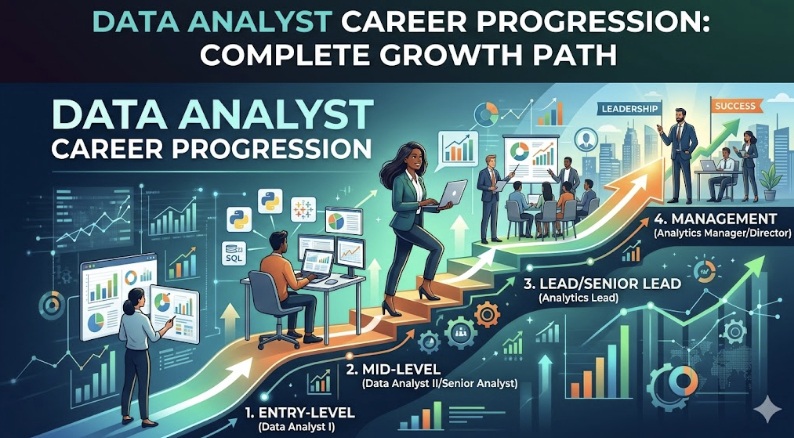
If you're wondering how to grow in the analytics field, understanding data analyst career progression is the first step. What does your journey look like after landing your first job? How do you move from basic reporting to high-impact decision-making roles? And most importantly—what skills actually matter?
In today’s data-driven world, companies rely heavily on insights to stay competitive. According to industry reports, data-related roles are among the fastest-growing jobs globally. But growth doesn’t happen automatically—you need a roadmap.
In this guide, you’ll discover a complete breakdown of the career progression for a data analyst, including roles, salaries, skills, tools, and practical steps you can apply immediately.
Source: https://www.bls.gov/ooh/math/data-scientists.htm
1. What is a Data Analyst Career Progression?
Data analyst career progression refers to the structured path professionals follow as they advance from entry-level roles to senior and specialized positions within the data analytics field.
At its core, progression means evolving from handling basic datasets to influencing strategic decisions through advanced analytics.
Why does career progression matter?
- It defines your long-term growth.
- Helps you plan skill development
- Increases earning potential
- Opens leadership opportunities
Typical Growth Path
The data analyst career path usually follows a linear yet flexible trajectory:
Entry-level → Mid-level → Senior → Specialized roles
Why professionals search for it
People often look for a career progression as a data analyst because:
- They feel stuck in repetitive reporting tasks
- They want higher salaries.
- They aim to transition into data science or leadership.
Entry vs Advanced Roles
| Factor | Entry-Level | Advanced |
|---|---|---|
| Work Type | Data cleaning, reporting | Strategy, modeling |
| Tools | Excel, basic SQL | Python, ML tools |
| Impact | Operational | Strategic |
| Salary | Low–Moderate | High |
Role of Skills & Specialization
Your growth depends heavily on:
- Technical expertise
- Business understanding
- Domain specialization (finance, healthcare, etc.)
Industry Impact
With industries becoming data-driven:
- Demand for analysts is rising
- Specialized roles are expanding.
- Remote global opportunities are increasing.
Why structured planning matters
Without a clear data analyst career roadmap, you risk stagnation. Planning helps you:
- Identify skill gaps
- Track career milestones
- Make strategic transitions
2. Data Analyst Career Path: From Beginner to Advanced Roles
Let’s break down the full data analyst career progression step-by-step.
Entry-Level Roles
1. Junior Data Analyst
A junior data analyst is your starting point.
Responsibilities:
- Cleaning datasets
- Creating reports
- Basic SQL queries
Skills Required:
- Excel
- Basic SQL
- Data visualization basics
Salary (India): ₹3–6 LPA
Example: Creating sales dashboards for a retail company.
2. Data Analyst Intern
Responsibilities:
- Assisting senior analysts
- Preparing datasets
- Learning tools
Best for:
Students and beginners
Mid-Level Roles
3. Data Analyst
This is where you gain independence.
Data analyst roles and responsibilities:
- Data cleaning and transformation
- Dashboard creation
- Insight generation
Skills:
- SQL and Python
- Tableau/Power BI
Salary: ₹6–12 LPA
4. Business Analyst
Focus shifts toward business impact.
Responsibilities:
- Translating data into strategy
- Stakeholder communication
Skills:
- Business intelligence
- Communication
5. BI Analyst
A business intelligence specialist.
Responsibilities:
- Dashboard automation
- KPI tracking
Tools:
- Power BI
- Tableau
Advanced Roles
6. Senior Data Analyst
A senior data analyst leads projects.
Responsibilities:
- Advanced analytics
- Mentoring juniors
- Decision-making support
Salary: ₹12–25 LPA
7. Analytics Manager
Responsibilities:
- Managing teams
- Defining data strategy
Specialized Roles
8. Data Scientist
Focus on predictive analytics.
9. Machine Learning Engineer
Builds AI models.
10. Data Engineer
Handles data pipelines.
Source: https://economicgraph.linkedin.com/resources/linkedin-workforce-report-january-2026
Data Analyst vs. Data Scientist: 2026 Career Growth
| Feature | Data Analyst Path | Data Scientist Path |
|---|---|---|
| Core Mission | Interpreting the past to optimize the present. | Predicting the future to build "intelligent" systems. |
| Early Career (0–2 yrs) | Junior Analyst: Data cleaning, SQL queries, and basic KPI dashboards. | Associate Scientist: Data prep, EDA (Exploratory Data Analysis), and model tuning. |
| Mid-Level (3–6 yrs) | Senior Analyst: Complex storytelling, stakeholder management, and process automation. | Senior Scientist: Designing end-to-end ML pipelines and experimental A/B testing. |
| Peak Roles (8+ yrs) | Analytics Manager / CDO: Driving business strategy and data governance. | Principal Scientist / AI Architect: Leading R&D and high-scale AI infrastructure. |
| Key Tools | SQL, Excel, Tableau/Power BI, Python (Pandas). | Python/R, PyTorch/TensorFlow, Cloud (AWS/GCP), Big Data (Spark). |
| Math Focus | Descriptive and Inferential Statistics. | Linear Algebra, Calculus, and Deep Learning theory. |
| 2026 Salary (US Avg) | $75k – $145k+ (Senior/Lead) | $110k – $190k+ (Senior/Principal) |
Key Growth Differences to Watch in 2026
The "AI Pivot": By 2026, the lines are blurring. Many Senior Data Analysts are evolving into Analytics Engineers, focusing on the "plumbing" (dbt, Snowflake) that makes data usable, while Data Scientists are moving toward MLOps, focusing on keeping models running in production.
Barriers to Entry: The Analyst path remains the most accessible "door" into the data world. Many professionals start as Analysts for 2 years, master the business context, and then upskill into Data Science.
Decision vs. Automation: Growth for Analysts is measured by how much they influence human decisions (CEOs, Managers). Growth for Scientists is measured by how much they automate decisions (Recommendation engines, Fraud detection).
Source: https://www.coursera.org/articles/how-much-do-data-analysts-make-salary-guide
3. Key Skills Required for Data Analyst Career Growth
To move forward in your career progression as a data analyst, skills are everything.
Technical Skills
1. SQL and Python
SQL and Python for data analysis are essential.
SQL → Query databases
Python → Automation, modeling
2. Excel & R
Still widely used for:
- Quick analysis
- Statistical modeling
Data Visualization
Data visualization helps communicate insights.
Tools:
- Tableau
- Power BI
Statistical Analysis
Understanding:
- Regression
- Probability
- Hypothesis testing
Business Understanding
You must connect data to decisions.
Example:
Instead of saying “sales dropped,” explain why and what to do next.
Soft Skills
Communication
Storytelling
Problem-solving
Real-world case study: “From Excel analyst to data scientist in 3 years.”
This is the story of "Maya," a Marketing Analyst who felt stuck in "spreadsheet purgatory" and successfully pivoted into a Data Science role at a mid-sized tech firm in exactly 36 months.
Year 1: The "Excel Wizard" Breaks the Ceiling
Role: Marketing Analyst (Manual Reporting)
The Problem: Maya spent 70% of her week copying and pasting data from Google Ads and Salesforce into Excel. She was a master of VLOOKUP and Pivot Tables, but she was a "reporter," not an "analyst."
The Pivot: She realized that to grow, she had to stop being the "data fetcher."
Key Moves: * Learned SQL: Replaced manual exports with direct database queries.
Automated Dashboards: Moved her weekly reports into Tableau, saving 15 hours of manual work per week.
The Result: She used her saved time to actually analyze the data, finding a $50k leak in ad spend that her manager had missed.
Year 2: From "What?" to "Why?" (The Python Leap)
Role: Senior Data Analyst
The Problem: Descriptive statistics (averages, totals) weren't enough. Stakeholders started asking, "Why is churn increasing?" and "Can we group our customers better?"
The Pivot: She stopped using Excel for analysis and started using Python (Pandas/Seaborn).
Key Moves:
Mastered EDA: Used Python to find hidden correlations between customer support tickets and subscription cancellations.
Statistically Minded: Learned A/B testing to help the product team decide which features to launch.
The Result: She was no longer just reporting the past; she was diagnosing the present.
Year 3: Predicting the Future (The Data Scientist Transition)
Role: Data Scientist (New Company)
The Problem: To get the "Data Scientist" title in 2026, Maya needed to move beyond visualization and into Predictive Modeling.
The Pivot: She built a "Churn Prediction Model" using her company's historical data as a side project.
Key Moves:
Machine Learning (ML): Learned Scikit-learn for regression and classification.
2026 Tooling: Mastered LLM-assisted coding to rapidly prototype models and focused on Model Evaluation (ensuring her AI wasn't biased).
The Portfolio: She didn't just list skills; she documented her churn project on GitHub, showing how it could save a company $200k/year.
The Result: She interviewed for a Data Scientist role and was hired because she could speak "Business" (from her Analyst days) and "Code" (from her self-study).
The Skill Evolution Summary
| Stage | Primary Tool | Primary Question | Career Value |
|---|---|---|---|
| Year 1 | SQL + Excel | "What happened last month?" | High (Efficiency) |
| Year 2 | Python + SQL | "Why did that happen?" | Higher (Insight) |
| Year 3 | Python + ML | "What will happen next month?" | Highest (Innovation) |
Maya’s Advice for 2026: > "Don't get obsessed with learning every math formula. Get obsessed with solving one business problem at a time. I didn't 'learn Python'—I learned how to use Python to stop doing manual work."
4. Tools and Technologies for Data Analyst Career Progression
Mastering tools accelerates your data analyst career progression.
Data Analysis Tools
Excel
Google Sheets
Programming
Python
R
Databases
SQL
NoSQL
Visualization Tools
Tableau
Power BI
Big Data Tools
Hadoop
Spark
Cloud Platforms
AWS
Azure
GCP
Pro Tip:
Learning cloud + big data tools can double your salary potential.
5. Certifications and Courses to Advance as a Data Analyst
Certifications validate your skills and boost credibility.
Popular Certifications
- Google Data Analytics Certificate
- Microsoft Data Analyst Associate
- IBM Data Analyst Certification
Learning Platforms
- Coursera
- Udemy
- edX
Why Certifications Matter
- Improve job opportunities
- Increase salary
- Build structured knowledge
Example:
A certified analyst often earns 15–30% more than non-certified peers.
6. Data Analyst Salary Progression
Understanding data analyst salary progression helps set expectations.
Salary Growth by Level
| Level | Salary (India) | Salary (US) |
|---|---|---|
| Entry | ₹3–6 LPA | $60K |
| Mid | ₹6–12 LPA | $80K |
| Senior | ₹12–25 LPA | $110K+ |
Factors Affecting Salary
- Location
- Skills
- Industry
- Experience
High-Paying Industries
- Finance
- Tech
- Healthcare
Why Data Analytics Pays Well
- High demand
- Skill shortage
- Direct business impact
7. How to Advance Your Data Analyst Career
Here’s a practical roadmap.
For Students
- Learn fundamentals
- Build projects
For Fresh Graduates
- Gain internships
- Master SQL & Python
For Working Professionals
- Learn advanced tools
- Move to senior roles.
For Career Switchers
- Start with the basics.
- Build portfolio
For Freelancers
- Build a personal brand.
- Work globally
Key Focus Areas
- Skill development
- Certifications
- Networking
- Portfolio building
Real Example:
A marketing professional transitioned into analytics by building 5 portfolio projects and learning Python.
8. Future Scope of Data Analyst Careers
The future of the data analyst career progression is extremely promising.
Key Trends
- AI & automation
- Big data growth
- Remote work
Career Expansion
- Data Science
- AI roles
- Analytics leadership
Global Demand
Companies worldwide are hiring analysts remotely.
Why the Future Is Strong
- Data is everywhere
- Businesses rely on insights.
- Technology is evolving
9. Final Verdict: How to Build a Successful Data Analyst Career
If you want long-term success, focus on:
- Continuous learning
- Mastering tools
- Building real-world projects
- Choosing the right specialization
Understanding career progression data analyst helps you:
- Plan better
- Earn more
- Grow faster
The journey isn’t linear—but with the right roadmap, it’s highly rewarding.
FAQs
Q. What is the career progression for a data analyst?
It starts from junior roles and progresses to senior, managerial, or specialized roles like a data scientist.
Q. What comes after a data analyst role?
Senior analyst, analytics manager, or data scientist roles.
Q. How long does it take to become a senior data analyst?
Typically, 3–5 years with consistent skill development.
Q. What skills are needed for a data analyst career growth?
SQL, Python, visualization, statistics, and business understanding.
Q. Is a data analyst a high-paying career?
Yes, due to high demand and business impact.
Q. Can I become a data analyst without a degree?
Yes, with certifications and a strong portfolio.
Q. Which industries hire data analysts the most?
Finance, healthcare, e-commerce, and tech.
Q. What is the future of data analyst careers?
Very strong due to AI, big data, and digital transformation.