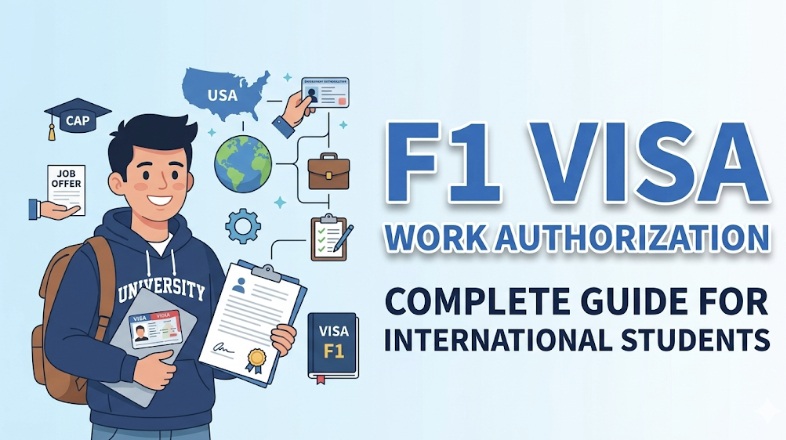
Studying in the United States opens doors to world-class education, but many international students also want to gain work experience while completing their degrees. This is where an F1 visa work authorization becomes essential.
But what does it actually allow you to do? Can you work while studying? What are the rules for internships and jobs after graduation?
Understanding work authorization F1 visa rules helps international students legally gain professional experience without risking their immigration status.
The United States provides several pathways for employment under the F-1 visa, including Optional Practical Training (OPT), Curricular Practical Training (CPT), and On-campus employment for F-1 students. Each option has specific eligibility requirements and time limits.
In this complete guide, you'll learn:
- What does work authorization for an F1 visa mean?
- The different types of employment available to international students
- Rules you must follow to maintain legal status
- How to apply for an F1 visa employment authorization
What Is F1 Visa Work Authorization?
F1 visa work authorization refers to the legal permission that allows international students studying in the United States on an F-1 visa to work under specific conditions during or after their academic program.
This system allows students to gain practical experience while ensuring their primary purpose in the U.S. remains education.
In other words, student F1 visa work authorization ensures international students can work legally without violating immigration regulations.
What Work Authorization Means for F-1 Students
When you hold an F-1 visa, you are primarily in the United States for education. However, the government allows limited employment opportunities that support learning and professional development.
These employment opportunities fall under F1 student work authorization policies managed by immigration authorities.
Examples include:
- On-campus jobs
- Internships related to your degree
- Training programs after graduation
Who Regulates F1 Visa Employment Authorization?
Two main authorities regulate F1 visa employment authorization:
- U.S. Citizenship and Immigration Services (USCIS)
- University officials, including the Designated School Official (DSO), approval
These institutions ensure that students meet F-1 student employment eligibility rules.
Why Students Research F1 Visa Work Authorization
International students often ask about work authorization for an F1 visa because:
- They want professional experience in the U.S.
- They want to offset education costs.
- They want to transition into long-term careers after graduation.
However, understanding the rules is critical because unauthorized employment can lead to serious immigration consequences.
Types of F1 Visa Work Authorization Available to Students
International students studying in the United States have several employment pathways under F1 visa work authorization regulations.
Each option allows students to gain experience at different stages of their academic journey.
The most common types of F1 student work authorization include:
1. On-Campus Employment
This allows students to work within their university without special approval from immigration authorities.
Example jobs:
- Library assistant
- Student support staff
- Dining hall employee
- Research assistant
These jobs fall under the On-Campus Employment for F-1 students rules.
2. Curricular Practical Training (CPT)
CPT allows students to participate in internships or work placements related to their academic programs.
This training must be part of the curriculum and requires Designated School Official (DSO) approval.
3. Optional Practical Training (OPT)
OPT is the most popular form of F1 visa employment authorization after graduation.
Students can work in the U.S. for up to 12 months in jobs related to their degree.
4. STEM OPT Extension
Students with degrees in science, technology, engineering, or mathematics may qualify for an additional work extension.
This program allows an additional 24 months of employment under STEM OPT extension rules.
5. Special Employment Authorization
In rare cases, students experiencing severe financial hardship may apply for limited work authorization.
On-Campus Employment for F1 Students
One of the simplest ways to obtain an F1 visa work authorization is through campus-based employment.
This type of job allows international students to work without applying directly to immigration authorities.
What Is On-Campus Employment?
On-campus jobs are positions located within the university where a student is enrolled.
These jobs must benefit the academic institution or student community.
Examples include:
- Campus bookstore jobs
- Library assistants
- IT support for university departments.
- Student services roles
These roles fall under the On-Campus Employment for F-1 students guidelines.
Working Hour Limits
International students must follow strict work limits:
- During academic sessions: Maximum 20 hours per week
- During school breaks: Full-time work allowed
This ensures students remain focused on their studies.
Why Many Students Start With On-Campus Jobs
On-campus jobs are often the easiest way to gain student F1 visa work authorization because they:
- Do not require separate USCIS approval
- Provide flexible schedules
- Allow students to build early work experience.
For example, many graduate students work as research assistants in university labs.
Curricular Practical Training (CPT): Work Authorization During Studies
Internships are a critical part of professional education in the United States. This is where Curricular Practical Training (CPT) becomes important.
CPT allows students to gain real-world experience related to their academic program.
What Is CPT?
CPT is a type of F1 visa employment authorization that allows international students to participate in internships, cooperative education programs, or field placements while still enrolled in school.
The work must be directly related to the student's major.
Eligibility Requirements
To qualify for CPT, students must:
- Complete at least one academic year
- Maintain full-time enrollment
- Receive Designated School Official (DSO) approval
Part-Time vs Full-Time CPT
Students can choose between two types:
- Part-time CPT: Up to 20 hours per week
- Full-time CPT: More than 20 hours per week
However, students who complete 12 months of full-time CPT may lose OPT eligibility, so careful planning is necessary.
Industries Using CPT
CPT is widely used in industries such as: Technology, Finance, Engineering, Business consulting
For example, many computer science students complete internships at software companies during their programs.
Optional Practical Training (OPT): Work Authorization After Graduation
Optional Practical Training (OPT) is one of the most widely used forms of F1 visa work authorization, allowing international students to work in the United States for up to 12 months in a job related to their field of study.
OPT allows students to gain professional experience immediately after completing their academic program.
This is one of the most common pathways for F1 visa employment authorization.
Pre-Completion vs Post-Completion OPT
There are two types of OPT.
- Pre-completion OPT: Students can work while still studying.
- Post-completion OPT: Students begin working after graduation.
Most students choose Post-completion OPT work authorization.
How to Apply for OPT
Students must submit the USCIS Form I-765 application.
The process typically includes:
- Receiving DSO recommendation
- Filing Form I-765
- Waiting for USCIS approval
- Receiving the Employment Authorization Document (EAD)
Once approved, students can legally work in the United States.
Industries Hiring OPT Students
Many companies hire international graduates through OPT programs.
Common industries include: Technology, Finance, Healthcare, Engineering, Data science
This experience often leads to long-term employment opportunities.
STEM OPT Extension: Additional Work Authorization for STEM Graduates
Students graduating from STEM programs may qualify for an extended work period.
The STEM OPT extension provides an additional 24 months of work authorization.
Eligibility Requirements
To qualify, students must:
- Hold a STEM degree
- Work for an employer registered with E-Verify
- Submit a training plan.
The training plan is completed using Form I-983.
Benefits of the STEM OPT Extension
The extension significantly expands career opportunities.
Students can: Gain additional professional experience, Build relationships with employers, Increase chances of long-term sponsorship.
Many students use this time to transition from F1 visa work authorization to an H-1B visa.
Rules and Restrictions for F1 Student Work Authorization
International students must follow strict immigration rules when using an F1 student work authorization.
Violating these rules can lead to serious consequences.
Key Rules Students Must Follow
Students must:
- Maintain full-time enrollment
- Work only in authorized positions.
- Keep immigration records updated.
Universities maintain a SEVIS work authorization record to track employment.
OPT Employment Requirements
For OPT jobs:
- Work must relate to your degree
- Students cannot exceed the unemployment limits.
- Job changes must be reported.
Students must also inform their Designated School Official (DSO) of employment updates.
Consequences of Unauthorized Employment
Working without work authorization F1 visa approval can result in:
- Loss of visa status
- Termination of SEVIS record
- Removal from the United States
This is why understanding work authorization for F1 visa rules is essential.
How to Apply for an F1 Visa Work Authorization
Applying for an F1 visa employment authorization involves several steps.
Step 1: Consult Your DSO
Your Designated School Official (DSO) approval is required before applying.
The DSO reviews eligibility and updates your SEVIS work authorization record.
Step 2: Prepare Required Documents
Students may need: Passport, Form I-20, Job offer or internship details, Academic transcripts
Step 3: Submit USCIS Application
Students applying for OPT must submit the USCIS Form I-765 application.
Step 4: Receive the EAD Card
Once approved, students receive the Employment Authorization Document (EAD).
This card proves legal student F1 visa work authorization.
Typical Processing Times
Processing can take: 2–4 months for OPT, Several weeks for CPT approval
Planning is essential.
Benefits of F1 Visa Work Authorization for International Students
Understanding the F1 visa work authorization opens valuable opportunities for international students.
1. Real-World Experience
Students gain professional experience in U.S. companies. This helps bridge the gap between education and employment.
2. Financial Support
On-campus jobs and internships help cover living expenses. This reduces financial pressure during studies.
3. Professional Networking
Working in the U.S. allows students to build industry connections. These networks often lead to long-term career opportunities.
4. Career Development
Many employers use internships and OPT programs to recruit international graduates. These opportunities can lead to sponsorship for long-term employment visas.
Final Thoughts: Understanding F1 Visa Employment Authorization
For international students studying in the United States, an F1 visa work authorization provides a structured pathway to gain valuable professional experience.
Programs such as Optional Practical Training (OPT), Curricular Practical Training (CPT), and the STEM OPT extension allow students to build careers while maintaining legal immigration status.
However, careful planning is essential.
Students should: Understand employment rules early, Work closely with their university's DSO, Apply for authorization well before deadlines.
By following the proper procedures, international students can safely transition from academic study to professional employment in the United States.
Moreover, you may try watching this video Work Authorizations, CPT, OPT, EAD Explained | How to work in the USA as an International Student.
Further, to know more, feel free to explore flashfirejobs.com.
FAQs
Q. What is F1 visa work authorization?
A. F1 visa work authorization is the legal permission allowing international students studying in the United States on an F-1 visa to work under specific conditions.
Q. Can F1 students work in the United States?
A. Yes. Students can work under programs such as On-campus employment for F-1 students, Curricular Practical Training (CPT), and Optional Practical Training (OPT).
Q. How many hours can F1 students work on campus?
A. Students can work up to 20 hours per week during academic sessions and full-time during school breaks.
Q. What is the difference between CPT and OPT?
A. CPT allows internships during studies, while OPT provides employment authorization after graduation.
Q. Do F1 students need employer sponsorship for OPT?
A. No. Students apply for OPT independently through the USCIS Form I-765 application.
Q. How long does an F1 student's work authorization last?
A. Standard OPT lasts 12 months, while STEM graduates may qualify for a 24-month STEM OPT extension.
Q. Can F1 students work off campus?
A. Yes, but only with approved authorization such as CPT or OPT.
Q. Does OPT lead to an H1B visa?
A. Many students transition from OPT to H-1B visas if their employer chooses to sponsor them.